
Federal Board (FBISE) · Live Online Tuition
Federal Board (FBISE) Online Tuition: Live Classes, Syllabus Support and Exam Preparation
Peak Wave Academy teaches Federal Board students online with live, teacher-led classes built around the FBISE syllabus, Student Learning Outcomes (SLOs) and the board's exam style. This guide explains how Federal Board tuition works, what each level needs and how to choose the right support.
Last updated November 2026 · Reviewed by our lead teacher (M.Com, M.Phil Finance, 16 years of teaching experience)
What Is Federal Board Online Tuition?
Federal Board online tuition is live, tutor-led teaching delivered over video for students who follow the curriculum of the Federal Board of Intermediate and Secondary Education (FBISE). A teacher explains each topic from the FBISE syllabus, students practise board-style questions, and regular tests show progress. It covers matric (SSC, Class 9 and 10) and intermediate (HSSC, Class 11 and 12), and can be one-to-one or in a group.
At Peak Wave Academy every Federal Board class is live, so students can ask questions the moment they get stuck. The rest of this page explains how the Federal Board works, what each level needs, how we teach and prepare students, and how parents can follow progress.
Federal Board Online Tuition at a Glance
Board
Federal Board of Intermediate and Secondary Education (FBISE), Islamabad
Levels
SSC Part I and II (Class 9 and 10) and HSSC Part I and II (Class 11 and 12)
Format
Live online classes, one-to-one or in a group, taught by experienced teachers
Subjects
Mathematics, sciences, computer science and commerce subjects
Progress tracking
Weekly tests and monthly progress reports for parents
Getting started
Free demo class first. Fees are shared after the demo.
Understanding the Federal Board (FBISE)
The Federal Board of Intermediate and Secondary Education (FBISE), based in Islamabad, conducts the Secondary School Certificate (SSC) examinations for Class 9 and 10 and the Higher Secondary School Certificate (HSSC) examinations for Class 11 and 12. It serves federal government institutions as well as many private schools and colleges that are affiliated with it, so Federal Board students come from very different schools and learning environments.
Federal Board teaching is built around the National Curriculum and Student Learning Outcomes, usually called SLOs. An SLO describes exactly what a student should know or be able to do after studying a topic, and board papers are designed to test those outcomes. This is why a student who only memorises answers often struggles with an unfamiliar question, while a student who understands each concept and has practised applying it can handle questions in any form.
The Board publishes assessment resources such as syllabi, SLO-based curriculum documents, model papers and past papers on its official website, www.fbise.edu.pk. Details can change from year to year, so students should always confirm the latest syllabus and notices there. We use these official resources as the base of every study plan.
Online tuition does not replace school. It fills the gap between what is covered in class and what a student needs to understand, practise and revise. Our job is to turn the Federal Board syllabus into a clear, manageable plan and to make sure the student actually follows it.
Not Sure Where to Start With Federal Board Tuition?
Join a free demo class. The teacher will check the student's current level and suggest a plan. Fees are shared after the demo.
Federal Board Online Tuition by Level
Federal Board students need different support at each stage. Here is what each level asks of a student and how we teach it.
SSC Part I (Class 9): Building Strong Foundations
Class 9 is where the board journey begins. Students meet new depth in Mathematics, Physics, Chemistry and Biology or Computer Science, and for many it is the first time their results count towards an external board examination. The priorities are concept clarity, learning how to read and answer an SLO-based question, and building steady study habits. We teach each chapter live, practise it immediately and test it every week, so gaps are caught early instead of piling up into Class 10.
SSC Part II (Class 10): The Board Exam Year
Class 10 is the final matric year, and the result shapes admission to intermediate colleges. The syllabus is complete, so the focus shifts to full-syllabus revision, chapter-wise tests, past paper practice and timed writing of long answers and MCQs. We pay particular attention to the areas where students typically lose marks, such as Mathematics and Physics numericals, Chemistry equations and Biology diagrams, and we build a realistic revision timetable that works backwards from the exam date.
HSSC Part I (Class 11): The Step Up to Intermediate
Class 11 is a significant jump in difficulty and independence. Students choose a group such as science, computer science or commerce, and the pace of teaching in college is faster than in school. We help students settle into the new subjects with clear, chapter-wise teaching, worked examples and regular practice, and we make sure the basics from matric are strong enough to support the new topics.
HSSC Part II (Class 12): The Final Intermediate Year
Class 12 results influence university admission, and many students also prepare for entrance tests at the same time. We help students plan their time so that board preparation stays on track, revise the Part I topics that are still examinable, and train with past papers and timed full-length practice. Weekly tests and monthly reports keep preparation honest and make sure weak topics are fixed well before the exam.
Federal Board Subjects We Teach Online
Choose one subject or a complete package. Each subject is taught live, with practice built into every lesson.
Mathematics
Mathematics rewards practice more than any other subject. We teach each topic from first principles, then work through varied questions, from direct exercises to multi-step problems, until the method becomes automatic. Students learn to show their steps clearly, which is where many marks are won and lost.
Physics
Physics combines concepts with numericals. We explain the idea behind each law, link it to everyday examples, and train students to write the data, formula, substitution and final answer with units in a clear order.
Chemistry
Chemistry needs both understanding and recall. We connect ideas such as atomic structure, bonding and reactions, and build reliable habits for writing and balancing equations and for learning definitions accurately.
Biology
Biology depends on precise terms and clear diagrams. We teach processes step by step, practise labelled diagrams and train students to answer in the way the board expects.
Computer Science
We cover the concepts and the problem-solving logic behind the syllabus and give students regular question practice, so that theory and application both stay sharp.
Accounting
For commerce students we teach the accounting cycle from journal entries and ledgers to the trial balance and final accounts, using worked examples and timed exercises.
Business Mathematics
Ratios, percentages, interest, profit and loss and other business calculations are taught with practical examples, so students see why the method works and not only how to apply it.
Statistics
We teach how data is collected, organised and summarised, from tables and graphs to averages and measures of spread, with plenty of practice on interpretation questions.
Economics
Demand and supply, markets, national income and money are explained with real examples, and students learn to write structured answers with correct economic terms.
Is your subject not listed here? Message us on WhatsApp and we will tell you honestly whether we can teach it.
How Our Federal Board Online Classes Work
Every student follows the same clear process, from the first demo class to the monthly progress review.
1
Free demo and level check
The student joins a short live class. The teacher teaches a topic from the Federal Board syllabus and asks a few questions to see what the student already understands, where the gaps are and how the student learns best.
2
A syllabus map and study plan
The teacher breaks the FBISE syllabus into chapters and SLOs and agrees a plan with the family, working backwards from the exam date so the full syllabus is covered with time left for revision.
3
Live lessons with worked examples
Each topic is explained live, then solved step by step on screen. Students then attempt questions themselves while the teacher watches and corrects, so mistakes are caught on the spot.
4
Practice and weekly tests
Students complete practice after every topic and take a short test every week. The results show which topics are secure and which need another look.
5
Monthly report and review
Parents receive a monthly progress report. The teacher and the family review it together and adjust the plan for the next month.
A typical week combines new topics taught live, practice on the same topics, a short test and a review of mistakes. The exact number of classes depends on the subjects chosen, the student's level and how close the exam is, and it is agreed after the demo class.
How We Prepare Students for FBISE Exams
Good exam preparation is not last-minute cramming. It is a steady process of learning, practising, testing and correcting. These are the four habits we build in every Federal Board student.
Past papers and model papers
Past papers and the model papers published by the Board show the style and balance of questions. We use them topic by topic first, and as full timed papers closer to the exam, then go through each answer to find and fix the cause of every lost mark.
MCQ technique
Multiple-choice questions reward careful reading and elimination. We teach students to read every option, remove the clearly wrong ones, watch for common traps and manage their time, and we practise with timed MCQ sets.
Short and long answer writing
Marks depend on how an answer is written as well as what it contains. Students learn to structure answers, use correct keywords, show working in numericals and draw neat, labelled diagrams.
Time management
Many students know the material but run out of time. Timed practice teaches them how long to spend on each question and when to move on.
A Four-Phase Revision Plan
Phase 1: Learn
Complete the syllabus and make sure every concept is understood.
Phase 2: Practise
Solve topic-wise questions and take weekly tests to find weak areas.
Phase 3: Simulate
Attempt full papers under exam conditions and review every mistake.
Phase 4: Polish
Revise weak topics, formulas, definitions and diagrams before the exam.
One-to-One or Group Classes: Which Is Right for Your Child?
Both formats are taught live by the same quality of teacher. The difference is how much personal attention a student gets and how they like to learn.
One-to-one classes
The teacher's full attention is on one student, and the pace, examples and practice are fitted to that student's level. This works best for students who are weak in a subject, have a tight schedule, are close to their exams or simply learn better without distractions.
Group classes
Students learn alongside others, hear different questions and see different ways of solving problems. This works well for confident students who want regular structure and the motivation of studying with peers.
Most students do well in either format. The demo class is a good way to see which one feels right, and the format can be changed later.
See How a Federal Board Class Works Before You Decide
Attend a free live demo class, meet the teacher and get a clear study plan for your child. Fees are shared after the demo.
How We Keep Parents Informed and Involved
Parents should never have to guess how their child is doing. Every student takes a short weekly test, and parents receive a monthly progress report that shows marks, strong topics and the areas that need more work. The teacher reviews the report with the family and adjusts the plan, and parents can message us on WhatsApp whenever they have a question.
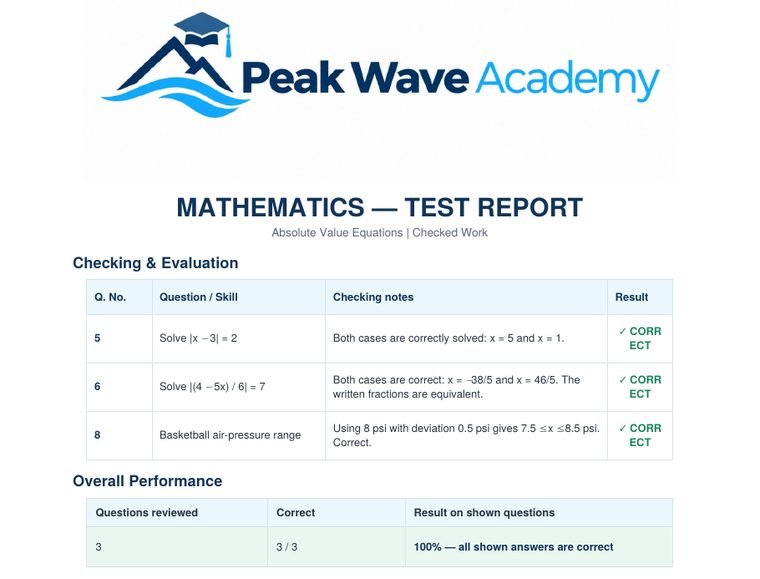
A sample checked-work report from Peak Wave Academy (student details removed).
How Parents Can Support Learning at Home
Keep a fixed study time. A regular slot every day builds the habit faster than long, irregular sessions.
Ask your child to teach you. Explaining a topic aloud is the quickest way to find what has not been understood.
Look at the weekly test together. Focus on the pattern of mistakes, not only the marks.
Protect sleep and breaks. Tired students retain less, especially in the weeks before the exam.
Contact the teacher early. A small worry shared in week two is easier to fix than a big gap found in week twelve.
Common Federal Board Problems and What Helps
Most students struggle for the same few reasons. Knowing the cause makes the fix much simpler.
I understand in class but forget in the exam
This usually means the topic was understood once but never pulled back out of memory. Short weekly tests, spaced revision and writing answers from memory build lasting recall, which is exactly what our weekly test routine is designed to do.
Numericals and word problems feel confusing
Most students lose marks because they jump straight to a formula. We teach a fixed routine: write what is given, write what is required, choose the method, solve step by step and check the answer or the units.
The syllabus feels too long
A long syllabus becomes manageable once it is split into chapters and SLOs with a date for each. We build that plan at the start and review it every month, so students always know what is done and what is left.
MCQs feel tricky
Wrong options are often written to look right. Students improve by learning the common traps, eliminating options and practising timed sets until careful reading becomes a habit.
Long answers lose marks
Examiners award marks for clear points, correct terms and neat diagrams. We practise structuring answers and compare student answers with model answers to see exactly where marks were missed.
Exam stress and poor time management
Stress usually drops when students know exactly what they have prepared. Regular testing, full timed papers and a calm final revision plan replace last-minute panic with confidence.
Official FBISE Resources Every Federal Board Student Should Use
The most reliable information about the syllabus and exams is published by the Board itself at www.fbise.edu.pk. We teach every student how to use each of these resources.
Syllabus and SLO-based curriculum
Shows exactly what can be asked. We map every study plan to it.
Model papers and assessment frameworks
Show the style of papers and how marks are distributed.
Past papers
The best source for practice and for learning how questions are phrased.
Date sheets and notices
Check exam dates and any changes announced by the Board.
Policies and paper patterns can change, so always confirm the latest details on the Board's website.
Who Teaches Federal Board Classes at Peak Wave Academy
Our lead teacher holds an M.Com and an M.Phil in Finance from the University of Karachi and has 16 years of teaching experience across schools, colleges, home tuition programmes and online academies. That experience includes teaching Federal Board and Karachi Board Mathematics for Classes 9 and 10, along with Accounting, Finance, Business Studies, Economics, Statistics and Business Mathematics.
Every student is matched with a teacher who suits their subject, level and board. Classes are taught live rather than through recorded lectures, because students learn best when someone is listening, watching their working and correcting them as they go.
“Thank you so much for your efforts, teacher. I highly appreciate your help.”
Class 9 Federal Board student (message shared on WhatsApp)
Federal Board Online Tuition: Frequently Asked Questions
What is Federal Board online tuition?
Federal Board online tuition is live, tutor-led teaching over video for students who follow the FBISE curriculum. A teacher explains each topic from the syllabus, students practise board-style questions, and regular tests show progress. It covers SSC (Class 9 and 10) and HSSC (Class 11 and 12) and can be one-to-one or in a group.
Which Federal Board classes and subjects do you teach?
We teach Federal Board students from Class 9 to Class 12 (SSC and HSSC). Subjects include Mathematics, Physics, Chemistry, Biology, Computer Science, Accounting, Business Mathematics, Statistics and Economics. If you need another subject, message us and we will tell you whether we can teach it.
Is online tuition effective for Federal Board students?
Yes, when it is live, interactive and built around practice. Students can ask questions during the lesson, the teacher can see their working and correct it, and regular tests show what has been learned. Passive recorded lectures are much less effective than a live teacher who responds to the student.
What are SLOs and why do they matter for Federal Board exams?
SLOs, or Student Learning Outcomes, describe what a student should know or be able to do after studying a topic. Federal Board papers are designed to test these outcomes, so understanding concepts and practising how to apply them matters more than memorising answers.
How do you prepare students for the Federal Board exams?
We split the syllabus into a dated plan, teach each topic live and practise it with topic-wise questions and weekly tests. Closer to the exam we use past papers and model papers under timed conditions and revise weak areas. Every mistake is reviewed so it does not repeat.
Do you use FBISE past papers and model papers?
Yes. Past papers and the Board's model papers show the style and balance of questions, so we use them for topic-wise practice first and full timed papers later. Students learn how questions are phrased and how marks are awarded.
Should my child choose one-to-one or group classes?
One-to-one suits students who are weak in a subject, have a tight schedule or are close to their exams. Group classes suit confident students who like learning with peers. The free demo class helps you decide, and the format can be changed later.
Can my child take only one subject?
Yes. Many students join for a single difficult subject, such as Mathematics or Physics, and add others later. You can also choose a package of several subjects. We agree the plan after the free demo class.
How can I track my child's progress?
Students take a short test every week, and parents receive a monthly progress report with marks, strong topics and areas to improve. The teacher reviews the report with the family and adjusts the study plan for the next month.
What does my child need for online classes?
A laptop, tablet or phone, a stable internet connection, headphones and a notebook. We guide new students through joining their first class, so no technical skill is needed.
How early should we start before the exams?
The earlier the better. Starting at the beginning of the academic year allows the full syllabus to be taught and revised properly. A focused revision plan can still help a few weeks before the exams, but a late start leaves less time to fix weak topics.
Can my child study from anywhere?
Yes. Classes are live online, so students can join from any city or country, as long as they have a laptop or tablet and a stable internet connection. We suggest class timings that fit the student's school day.
Do you guarantee marks or grades?
No. Results depend on attendance, practice and effort, and nobody can honestly guarantee marks. We promise structured teaching, regular testing, honest feedback and a clear plan.
Who will teach my child?
Each student is matched with a teacher who suits their subject, level and board. Our lead teacher has 16 years of teaching experience and an M.Phil in Finance from the University of Karachi. You can ask us about the teacher before booking a demo.
How do I book a free demo class?
Message us on WhatsApp or use our contact page. Tell us the student's class, subjects and preferred timings, and we will arrange the demo. Fees are shared after the demo, once we have met the student.
Also explore: Online tuition in Pakistan · All our courses · About Peak Wave Academy
Ready to Start Federal Board Online Tuition?
Book a free demo class, meet the teacher and get a clear plan for your child's syllabus and exams. Fees are shared after the demo.